


“If, in the world before the arrival of capitalism, 95% of the world’s population lived in extreme poverty (less than a dollar a day), and today, with a population eight times larger, before the pandemic, that figure was below 5% (at the end of the twentieth century it was 20%), how is it possible that economic theory claims that this structure [the market structure that came with capitalism] doesn’t work?”1
— Javier Milei, El camino del libertario
“Things were better back then.”
You’ve heard it at the bar, over dinner with family or friends, on TV, all over social media. At best, it comes from someone harmless and a little nostalgic, pining for the good old days, when everything was cheaper and you earned more for less effort.
At worst, the “things were better back then” mantra becomes one more excuse for the thugs and vandals who trash our cities, as we’ve seen recently across Europe, especially in France: Limoges city hall set on fire, banks and shops stormed in Paris, cars torched. All this in a country where the state spends 57% of everything the economy produces.
Peaceful or not, both camps are quick to blame everything on “capitalism”, usually without knowing the first thing about it. So I have a simple question for all these crusaders against capitalism: back when?
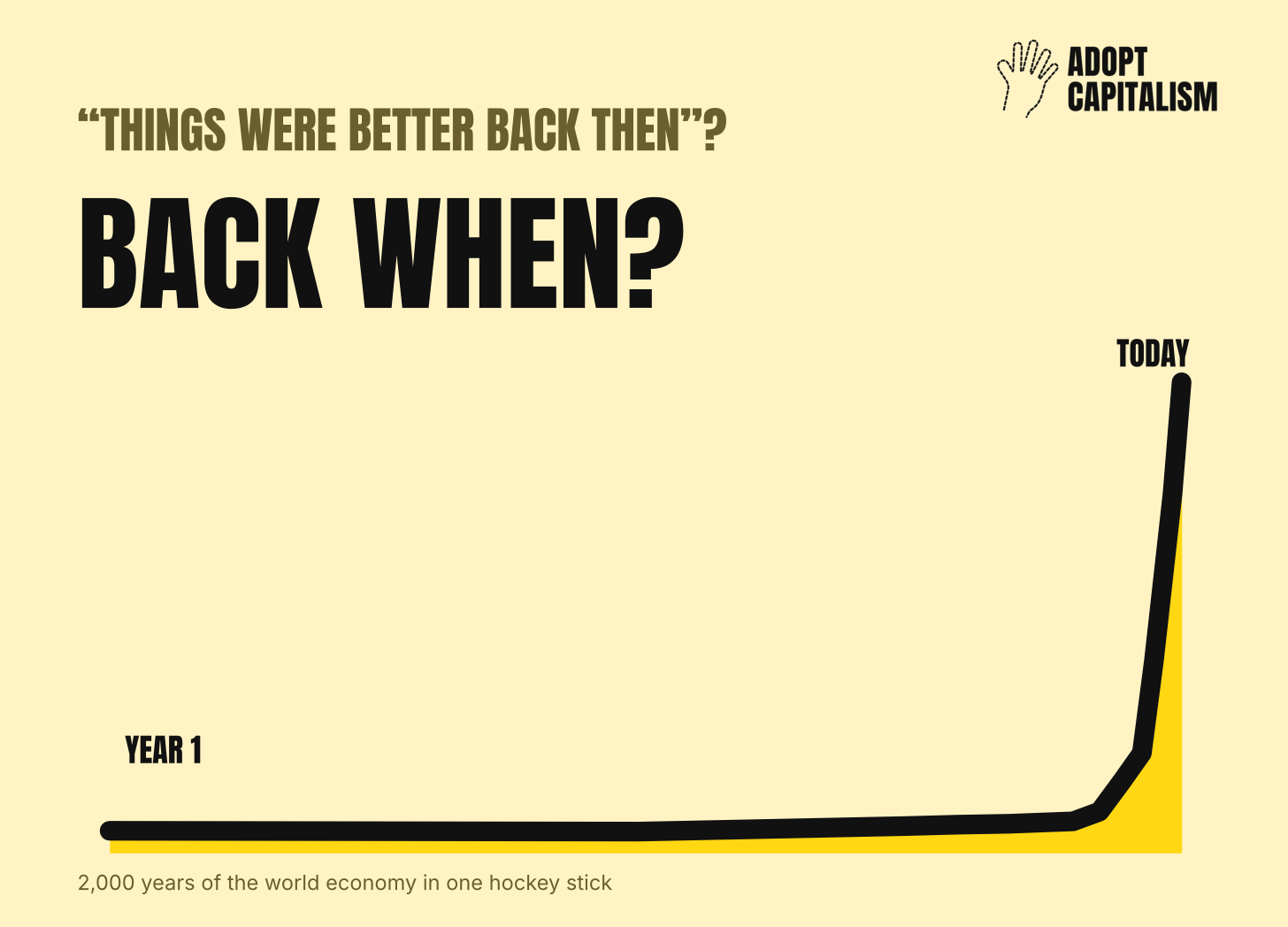
There’s a chart that answers that question better than a thousand TV debates. Economists call it the hockey stick. Once you’ve seen it, “things were better back then” will sound like exactly what it is: nonsense.
The man who measured two thousand years of economic history
Angus Maddison (1926–2010) was a British economist who devoted his life to a slightly crazy project: estimating how much the average human being on Earth produced, from the year 1 to the present day. To do it, he painstakingly combed through tax records, wage data, censuses and archives from all over the world. The result is the most widely used data series for studying long-run growth, still maintained today by the Maddison Project at the University of Groningen.
Here’s what Maddison’s original data show.
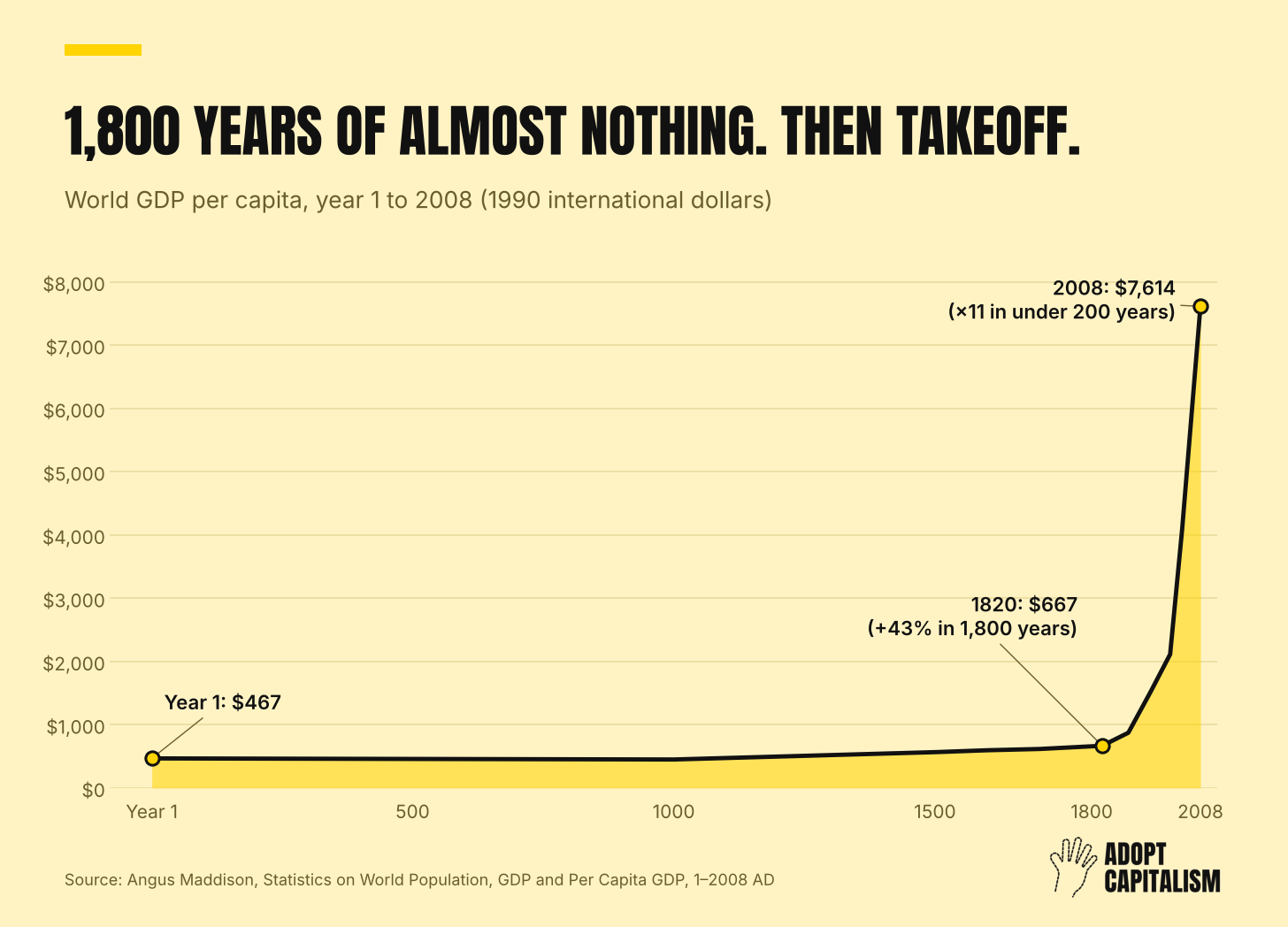
In the year 1, world GDP per capita was about $467.2 By 1820 it had reached $667. That’s a measly 43% in 1,800 years. In annual terms: 0.02% growth a year. At that pace, it takes about 3,500 years to double your income. Dozens of generations were born, lived and died in the same poverty as their ancestors.
Then something changes. Between 1820 and 2008, GDP per capita multiplies by 11. And it hasn’t stopped since. Maddison’s original data end in 2008, but I’ve extended the series to the present day.3 Here’s the blade of the hockey stick, up close.
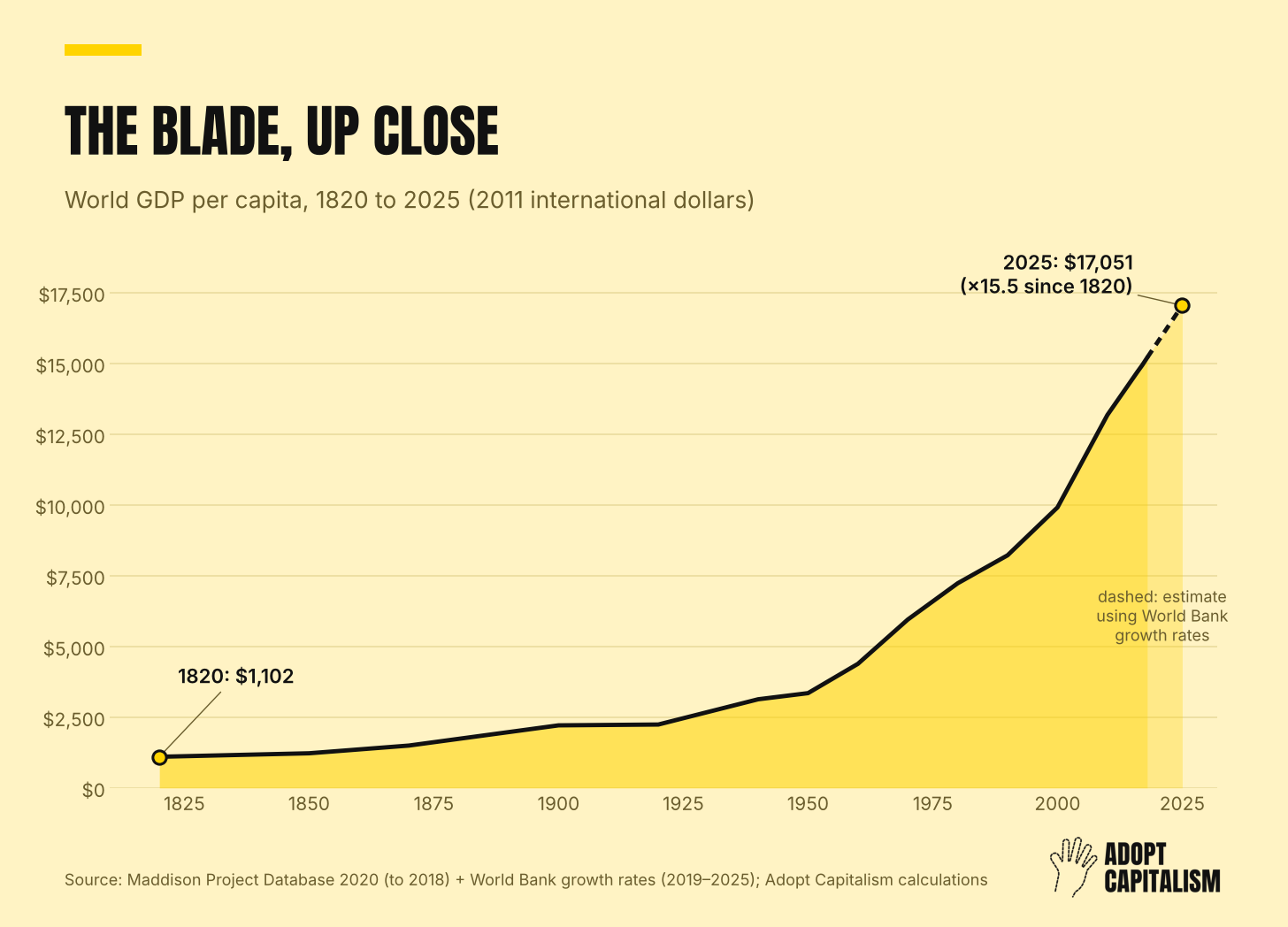
Between 1820 and 2025, the average wealth of every person on Earth grew roughly fifteenfold.4 Not even a global pandemic managed more than a scratch on the curve: world GDP per capita fell 3.8% in 2020 and was already climbing again the following year.
And here’s the kicker: all this happened while the world’s population went from about 1 billion in 1820 to more than 8 billion today. Eight times as many people, each of them, on average, fifteen times richer. Which means total world GDP has grown more than a hundredfold!
That’s the hockey stick: an endless flat handle, then a blade that shoots straight up. And the blade starts precisely when capitalism is born, which has no official birthday, but which I personally like to date to the publication of Adam Smith’s magnificent The Wealth of Nations in 1776.
Funny, isn’t it? Maybe private property, free trade, the division of labor and the pursuit of profit, guided by Adam Smith’s famous “invisible hand”,5 have delivered extraordinary results after all. So much for the statist nonsense that the mainstream media, so often left-leaning and anti-capitalist, bombard us with every day.
Getting rich faster and faster
There’s one detail that makes all this even more remarkable: capitalism didn’t just bring economic growth into human history at last, it kept making it faster. Generally speaking, countries that took the free-market road have doubled their wealth faster than those that went before them.
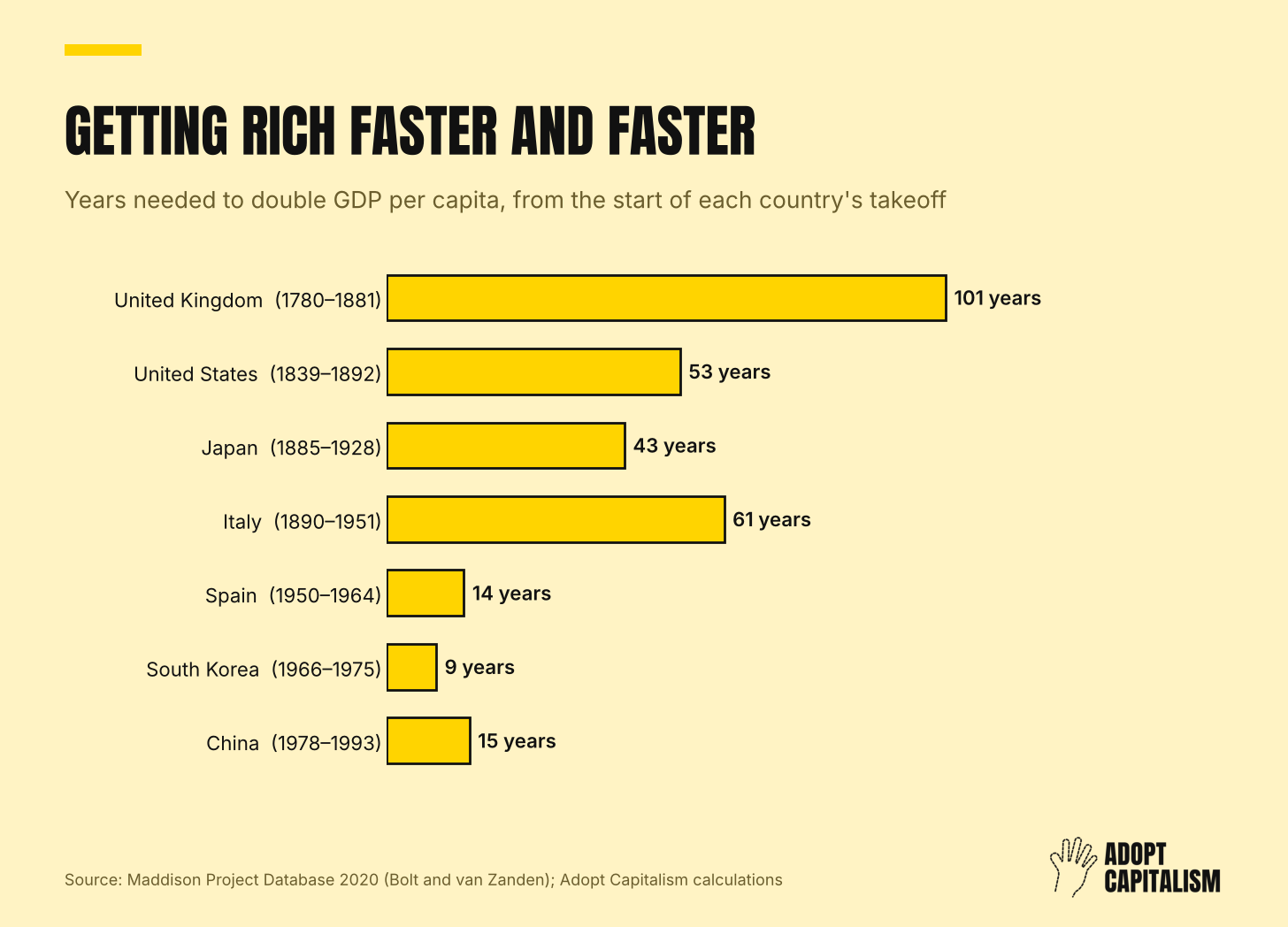
The United Kingdom, the pioneer of free markets (it’s no coincidence that Adam Smith was Scottish), took about a century to double its GDP per capita after 1780. The United States took 53 years, Japan 43. Italy, starting in 1890, took 61. Spain, from 1950, a mere 14. South Korea, from 1966, just 9 years. China, after its market reforms of 1978, 15.
Why do latecomers run faster? The easy answer is: “they just copy the technology of rich countries.” But if copying were enough, every poor country would already be rich, because the technology is right there, available to anyone. Instead, only those who open their doors to the market take off.
The most brutal proof is Korea. Same language, same history, same culture, split in two after the Second World War: markets in the South, state planning in the North. In 2018, the average South Korean produced 24 times as much as the average North Korean, again according to the Maddison Project. China only started running when, from 1978 onwards, Deng Xiaoping allowed farmers to sell their own harvests and private businesses to emerge. India accelerated after its 1991 liberalization.
And these aren’t isolated cases. Every year, the Fraser Institute’s Economic Freedom of the World report ranks countries by how economically free they are. The verdict is clear: in the freest quarter of countries, average income is 6.2 times that of the least free quarter. The poor gain too: there, the poorest 10% of the population earn 7.8 times as much. And people live, on average, about 17 years longer. You can only copy other people’s ideas where you’re free to invest, trade and profit from them.
The problem: according to some economists, none of this should happen
This is where the story gets interesting, because the hockey stick is a punch in the gut for a large part of academic economics. To see why, you need a little context.
Since the late nineteenth century, thanks to economists such as William Jevons, Léon Walras, Alfred Marshall and the Austrian Carl Menger, economics has had a toolbox known as neoclassical economics, or marginalism: a general approach that explains prices, output and income through the mathematical model of supply and demand. Supply and demand, thinking “at the margin”, equilibrium theory: in neoclassical economics these are tools, and like all tools, what they produce depends on who’s using them. Milton Friedman and the Chicago School used them to defend the market better than anyone. Others, starting with Paul Samuelson’s “neoclassical synthesis”, which fused them with the ideas of John Maynard Keynes, used them to justify ever more state intervention.
Neoclassical theory covers what we now call microeconomics, and together with Keynesian economics it forms the neoclassical synthesis, which, tragically in my view, dominates the economics taught in most university departments across the Western world. I’ll probably devote a whole piece to that too.
The main problem arises when the tools of neoclassical economics look at the economy as if it were a photograph: a market in equilibrium, where prices and quantities have already settled, all firms are identical and everyone knows everything. This is so-called “perfect competition”: an elegant mathematical model, useful for answering some questions. But it leaves out exactly what creates wealth: the entrepreneur who spots an opportunity nobody else sees, the mistake you learn from, the new thing that didn’t exist yesterday. In a photograph, nobody invents anything. And once that photograph becomes the yardstick for judging the real world, the actual market always looks “defective”. That’s the theory of market failures, from which flows the idea that the state is needed to fix it.
To understand why the hockey stick throws the neoclassical framework into crisis, you need a concept that some economists have been carrying around since Malthus: the law of diminishing marginal returns. It sounds complicated, so let me explain it with an example.
Picture a field farmed by a single farmer, producing 100 sacks of grain. Add a second farmer to the same field: output rises, but to 180 sacks, not 200. The third adds even less, and so on. The field never gets any bigger, so every extra pair of hands adds less than the one before. That’s diminishing marginal returns.
This is exactly the world Thomas Malthus described in 1798. In a nutshell: if population grows and land doesn’t, every extra mouth means less food for everyone. Famine and misery were to be humanity’s inevitable fate.
For 1,800 years, Malthus would have been right: the flat handle of the hockey stick is exactly that. But if Malthus had been right after 1800 as well, eight times as many people should have meant far poorer people, practically starving. The exact opposite happened. As Milei writes in his excellent book El camino del libertario: “from a neoclassical point of view, none of this makes sense.”6
The Austrian School (Carl Menger, Ludwig von Mises, Friedrich Hayek, Murray Rothbard), heir in part to Adam Smith’s free-market tradition, reaches conclusions similar to Milton Friedman’s (less state, more market), but by a different route:7 it looks at the economy as a film. The market isn’t a state of rest but a process of discovery: millions of people, each holding a scrap of knowledge that no planner could ever gather, trying things, making mistakes and correcting them. Hayek explained it in 1945 in a now-famous essay, “The Use of Knowledge in Society”. Prices are the signals that coordinate this apparent chaos, and profit is the reward for whoever correctly guesses what other people will need. At the center there’s no equilibrium: there’s the entrepreneur.
Even within academic economics, some people began to see the problem. Robert Solow (Nobel Prize, 1987) was among the first to measure it. In a famous 1957 study, he found that most American growth in the first half of the twentieth century couldn’t be explained by more machines or more hours worked, but by a “residual” he called technical progress. The trouble is that, in his model, this progress comes from outside, like manna from heaven: it’s there, but the theory can’t say where it comes from.
Paul Romer (Nobel Prize, 2018) went a step further. His insight is simple: ideas aren’t like things. If I’m using a tractor, you can’t use it at the same time. But the formula for a vaccine, once discovered, can be used by a thousand factories at once, and making the billionth dose doesn’t require rediscovering it (here’s the Nobel committee’s explanation). The cost of an idea is paid only once; the benefits multiply with every person who uses it. That’s why more people, more minds and bigger markets mean not less but more wealth for each of us. These are increasing returns to scale: the engine behind the blade of the hockey stick.
Fine. But where do ideas come from? Certainly not from the state. They come from people who are free to try, to take risks and to profit when they’re right. Romer himself stresses that without the chance to profit, nobody invests time and money in discovering something new. Ideas are born everywhere, but they only become wealth where there’s private property, profit and freedom to trade.
For centuries, imperial China produced extraordinary inventions, from paper to gunpowder, but without those three ingredients the blade of the hockey stick never took off. The puzzle is so famous that it has a name: the “Needham Question”, after the British historian Joseph Needham, who spent his life asking why the scientific and industrial revolutions didn’t happen in China, even though it had been technologically ahead of Europe for centuries. Among the most convincing answers is precisely this one: a centralized empire, where the state controlled trade and merchants, left no room for private initiative. The world’s prosperity took off instead where markets were freest: in England and the Netherlands.
Adam Smith saw it all coming
One of the most extraordinary things about Adam Smith is that he didn’t just launch the age of capitalism, in my view, with The Wealth of Nations: in that very book he anticipated the hockey-stick growth that capitalism would produce in the centuries that followed.
To see how, let’s start with his famous pin factory. A single worker on his own, Smith wrote, could barely make one pin a day, and certainly not twenty. But ten workers dividing the eighteen distinct operations between them could turn out 48,000 pins a day: 4,800 each.
That’s the division of labor: everyone specializes in what they do best and trades for the rest. And Smith added a stroke of genius: the division of labor is limited by the extent of the market. The bigger the market, the more people can specialize, and the more productivity grows. And with it, wellbeing and wealth for everyone.
Read that again: more people and more trade make each of us more productive and richer. These are exactly the increasing returns Malthus failed to see. Without knowing it, Smith had described the hockey stick before it even existed. I’ll be writing about Smith a lot in this newsletter, because he’s the father of everything you’ll read here.
Is monopoly always a market failure?
Remember the “photograph” of perfect competition I told you about earlier, the one that becomes the yardstick for judging the real world? The increasing returns I’ve just shown you, from Smith’s pin factory and Romer’s ideas, don’t only undermine Malthus. They undermine that photograph too, and with it the theory of market failures, which Keynesians and interventionists have been using for decades to justify ever more state.
To see why, think of a baker. The more bread he bakes, the less each loaf costs him, but only up to a point: then the oven is full, he needs overtime, and costs start rising again. No baker can grow forever, and the market stays full of small bakeries. That’s the world of the photograph.
Now think of someone who makes software or a vaccine. The first copy costs millions, even billions, in research, but every extra copy costs next to nothing. The more they sell, the more the cost per unit falls, and it keeps on falling. Economists have an unlovely technical name for this situation: “non-convexity”. In this world, the biggest player is also the most efficient: it can cut prices, keep growing and take over the whole market. The end point is monopoly, which is precisely the example that advocates of state intervention most often cite as the great “market failure”.
For the theory of market failures, monopoly is a bad thing. In this view, a monopolist will raise prices, produce less and leave some consumers empty-handed. In the jargon: the market drifts away from the Pareto optimum, the ideal situation in which nobody can be made better off without making someone else worse off.
Let me sum up the paradox, because this is the crux. You’ve seen that the blade of the hockey stick comes from increasing returns: division of labor, ideas, ever-larger markets. But increasing returns also produce ever-larger firms and more concentrated markets: it’s the same phenomenon, seen from a different angle. If this theory calls concentration a “market failure”, then the engine that lifted billions of people out of extreme poverty would be... a defect. Something doesn’t add up.
Javier Milei, Argentina’s president but first and foremost, in my view, the greatest living economist, says he ran headlong into exactly this paradox. He found the answer in a text by Murray Rothbard: the chapter “Monopoly and Competition” in his treatise Man, Economy, and State (1962). After reading it in a single evening, he admitted that what he had been teaching about market structures for more than twenty years, the product of the Keynesian and neoclassical training he’d received at Argentine universities, was wrong.
Rothbard’s point is simple: in a free market, there is no such thing as a harmful monopoly. The monopoly that does real damage is the one created by the state: an exclusive license, a tariff, a regulation written to order, a state-owned company shielded from competition. Rothbard explains it in chapter 10 of the book, which the Mises Institute makes available free online.
Picture ten companies making cell phones. One invents a better, cheaper phone, and the other nine go under. Is that a monopoly? Yes. Is it a bad thing? No: the monopolist is actually a benefactor. It won every customer by offering more for less. And if tomorrow it raised its prices or stopped innovating, nothing would stop a competitor from coming in and taking the market away.
This isn’t theory. In 2007, Nokia sold about half of all the smartphones in the world. Then the iPhone arrived, and within a few years the Finnish giant collapsed. Kodak dominated photography; digital wiped it out. The reward for a monopoly won in the marketplace is temporary: it lasts only as long as you serve customers better than anyone else.
All of this also ties into the theory of “creative destruction” described by Joseph Schumpeter. Who wins? All of us. Creative destruction lowers prices, improves quality and moves workers and capital to where they’re needed most. Think of what’s inside a $200 smartphone today: camera, GPS, music player, encyclopedia, bank branch. Thirty years ago you’d have had to buy all of that separately, spending thousands of dollars, and much of it didn’t even exist. It’s no coincidence that the 2025 Nobel Prize in Economics went to Joel Mokyr, Philippe Aghion and Peter Howitt precisely for explaining how innovation and creative destruction generate sustained growth. Companies die, products disappear, but society as a whole grows richer.
Now try competing with a monopoly protected by law: a taxi license (in many European countries the sector still hasn’t been opened up), a profession with a capped number of licenses, a state-owned company. There, being better isn’t enough: you need the state’s permission. That’s the monopoly that hurts, because costs for everyone become enormously higher, all to protect the privileges of a few. And even those few, without protection, could move into more productive activities and end up earning far more themselves: that’s exactly the positive change that the state, by intervening, blocks. But that’s another story, and I’ll dig into it in another piece.
Malthus was wrong (and so are his heirs)
Today more than 8.2 billion people live on Earth, according to the United Nations. Malthus would have predicted apocalyptic famines. Instead:
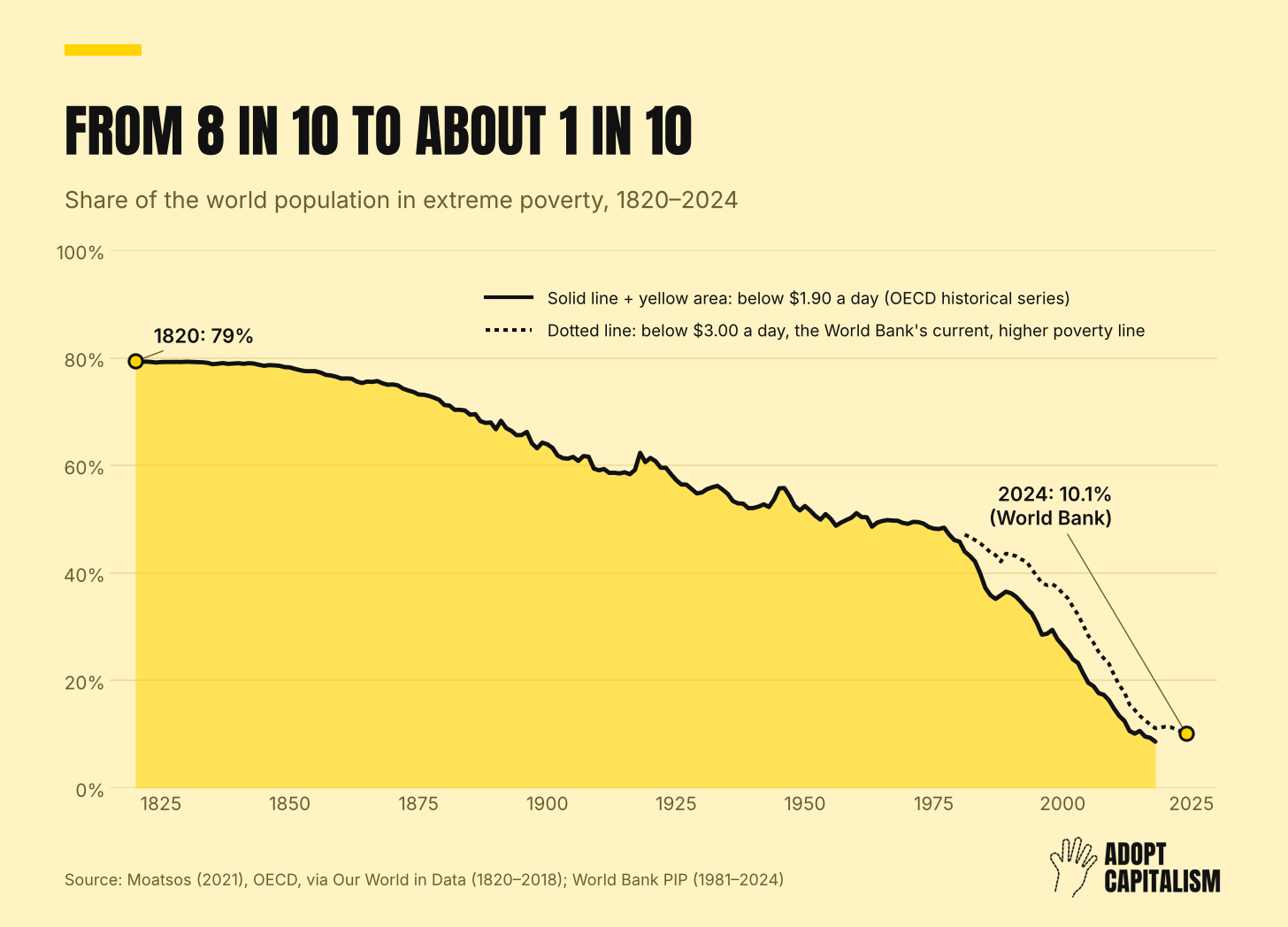
In 1820, according to estimates published by the OECD, about 8 in 10 people lived in extreme poverty. By 2018 it was fewer than 1 in 10. Using the higher threshold the World Bank uses today ($3 a day), the figure for 2024 is 10.1%: about 837 million people, roughly one in ten. Still too many, of course. But in a world with eight times as many inhabitants.
And yet Malthusianism never dies: it just changes clothes. In 1968 the biologist Paul Ehrlich published The Population Bomb, which predicted hundreds of millions of deaths from starvation in the 1970s. In 1972 the Club of Rome published The Limits to Growth: resources would run out and growth would collapse. None of it happened.
Sadly, these ideas are still everywhere in the media and they distort how people see reality, especially the young, who worry obsessively about defending green, anti-capitalist policies to “save the planet and the future of the next generations”. When in fact the future of the planet can only be saved by free markets, growth and innovation, which bring more prosperity and better environmental protection too.
The data say the exact opposite of what the doom-mongers claim. According to Yale’s Environmental Performance Index, environmental performance scores are “highly correlated with country wealth”: the richest countries are also the cleanest. And the freest: one study that cross-checked that index against economic freedom found that “free” countries score an average of 76 out of 100 on the environment, while “repressed” countries score 50.
The Malthusians’ fundamental error isn’t just a bad forecast: it’s a wrong idea of what a human being is. If every extra person is just a mouth to feed, rather than also a mind that can invent, then the “solution” becomes having fewer people. And when that idea gets into power, mistakes become tragedies.
It really happened. China’s one-child policy (1980–2015) grew partly out of Club of Rome-style doomsday projections: the scientist who designed it, Song Jian, had been inspired by the mathematical population-control models associated with the Club of Rome itself.
Today the same pattern repeats itself in new words: human beings portrayed as a problem for the planet, and the state called in to decide how much we may produce or consume. Those who see people as the problem, rather than the solution, sooner or later ask the state to “correct” them. Today’s prophets of ecological apocalypse would do well to remember that.
Adam Smith, like Alexander Fleming
In 1928, Alexander Fleming discovered penicillin. According to Guinness World Records, it has saved more than 200 million lives. Nobody disputes that Fleming was a benefactor of humanity.
Now look at this chart.
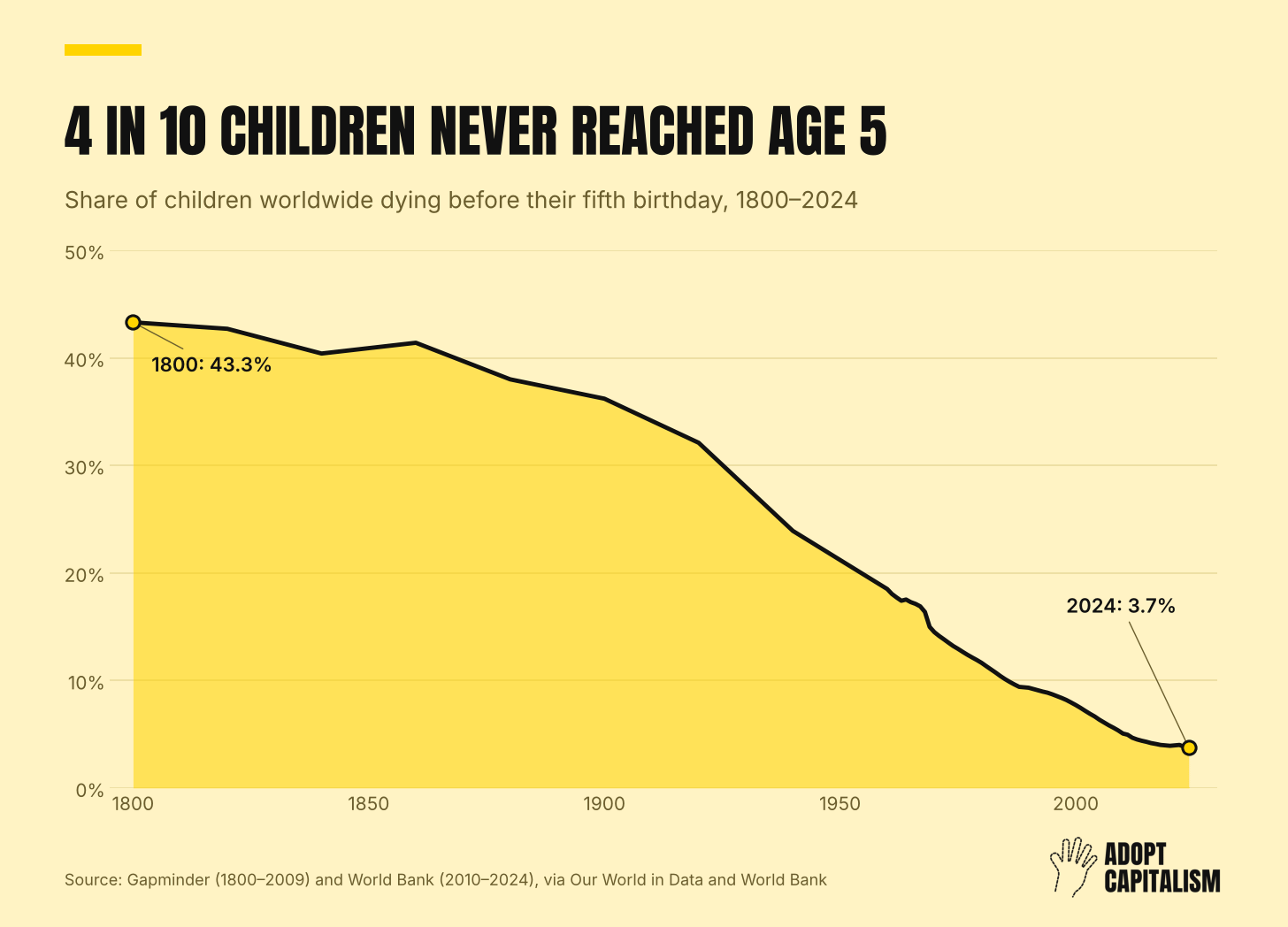
In 1800, more than 4 in 10 children died before their fifth birthday. In 2024, fewer than 4 in 100 (3.7%). Average life expectancy worldwide has gone from about 29 years to more than 72.
What made all this possible? Doctors, scientists, vaccines, antibiotics, of course. But also sewers, clean water, abundant food, heated homes. All of that costs money, and only a rich society can afford it. And a society only becomes rich if it’s free: free to trade, to divide up labor, to innovate, to make a profit. It was that freedom that funded the research and turned penicillin into a drug that costs pennies, within reach of billions of people. And penicillin is just one example: economic growth has lifted billions of people out of poverty, and less poverty, on its own, means fewer children dying.
Do the math: about 130 million babies are born in the world every year. At the child mortality rate of 1800, more than 50 million of them would die before turning five. Today the figure is about 5 million. That’s tens of millions of children saved, every single year.
Adam Smith didn’t invent a drug. He explained how wealth is created, and the societies that listened to him became rich enough to save their children. If Fleming was a benefactor of humanity, so was Smith. To my mind, even more so.
“Things were better back then”? Back when?
Let me go back to the bar where I started. When someone tells you things were better back then, ask them: back when?
In 1800, when 4 children in 10 died young? In 1820, when 8 people in 10 lived in the most abject poverty? In the Middle Ages, when average income was the same as in the time of Emperor Augustus?
You don’t even need to go back that far. Take just the last thirty years, the ones many people remember as “the good old days”. In 1990, according to the World Bank, 2.3 billion people lived in extreme poverty. Today the figure is about 837 million, even though the world’s population has grown by almost 3 billion in the meantime. Since 2000, world GDP per capita has risen by more than 70%. In 1990, more than one child in 11 died before the age of five. Today it’s fewer than one in 25, according to data from the World Bank and Our World in Data. And while average life expectancy worldwide was 66 in 2000, today it’s over 72.
Then there’s everything the numbers don’t capture. Today about 6 billion people are online: three-quarters of humanity carries access to all the world’s knowledge in their pocket, for free. You can learn anything, work from home for a client on the other side of the planet, or open an online store for a few dollars. Thirty years ago, almost none of this existed. Whoever says things were better back then is usually typing it on a smartphone.
Even more absurd are those who blame capitalism for their own situation. It’s exactly the other way round: capitalism made almost everything we have possible. If anything, the problem is how little capitalism we have left.
So why does capitalism get such a bad press? One reason was explained by James Buchanan, winner of the 1986 Nobel Prize, with public choice theory: politicians and bureaucrats are not angels. They respond to incentives, like everyone else. And their incentive is to make the state grow: more public spending means more power, more cushy jobs, more votes to buy (here’s a good introduction to public choice theory). Every dollar that passes through their hands is a dollar taken away from free cooperation between people, taken by force from those who work and produce, and handed out according to political convenience.
Some numbers from the Western world speak for themselves, and they’re alarming. To take just one example: in 2024, public spending in the European Union was 49.2% of GDP, and in France 57.1% (Eurostat). Half of everything the EU produces passes through the hands of the state. For a libertarian like yours truly, that’s chilling.
The real tragedy: they’re winning
And here’s the part that should worry us. The attack on free markets is no longer just political: it’s cultural. In schools, in universities, in the media, “capitalism” has become almost a dirty word. In Europe and the United States, the appetite for more state keeps growing: more taxes, more regulation, more subsidies, more protectionism, more debt.
Margaret Thatcher and Ronald Reagan are gone. Today the brightest light comes from Argentina, where Javier Milei is trying to dismantle decades of statism. But the West as a whole is heading in the opposite direction.
That’s an enormous danger. Because the hockey stick is not a law of nature: it’s the fruit of free human action, which can be obstructed or, worse still, banned altogether. The Soviet Union, Venezuela, Cuba and North Korea prove it, to name just a few. And so does Argentina, Milei’s own country. And the highest price is always paid by the poorest: they’re the ones capitalism lifted out of misery, and they’re the first to fall back into it when the market is smothered.
In 1913, according to the Maddison Project, Argentina was among the ten richest countries in the world by income per head: the average Argentine was richer than the average German or Frenchman, and almost twice as rich as the average Spaniard. In Europe there was even a saying at the time: “as rich as an Argentine”. Then came a century of Peronism, nationalizations, inflation and welfare dependency. The result: between 1913 and 2018, Argentina’s GDP per capita grew threefold, Spain’s tenfold. By 2018, the average Spaniard produced 70% more than the average Argentine. That’s why Milei fights statism with such passion: he watched it destroy his country.
Why this newsletter exists
Adopt Capitalism exists to remind us where our prosperity comes from, and why it’s worth defending. Here you’ll find the great ideas of classical liberalism, free-market economics and libertarianism, from Adam Smith to Milton Friedman, from Hayek to Milei, made clear and exciting. And you’ll get analysis of today’s world, seen through a libertarian’s eyes.
Capitalism is under attack. Adopt it.
If you enjoyed this piece, subscribe and forward it to that friend who’s convinced things were better back then.
Stay free,
— GO
Milei uses the old poverty line of one dollar a day and pre-pandemic data. With the World Bank’s current line ($3 a day), the share of people in extreme poverty is about 10%. The bar moves; the story doesn’t.
These are “1990 international dollars”: a unit of measurement that strips out the effects of inflation and of price differences between countries. In practice, those dollars buy the same things in any era and any place, so the comparison is fair.
How I extended the series: up to 2018 I use the Maddison Project Database 2020; for 2019–2025 I apply the World Bank’s annual growth rates for world GDP per capita. The two sources measure things slightly differently, so the most recent years (the dashed line in the chart) are an estimate. The same method applies to the charts on poverty and child mortality: historical series (OECD and Gapminder) joined to recent World Bank data.
If you’re wondering why 1820 is worth $1,102 in this chart rather than $667: the updated Maddison Project uses 2011 dollars instead of 1990 dollars. The unit of measurement changes; the story doesn’t.
Yes, the hand-shaped cursor on my Substack is Adam Smith’s invisible hand. Forgive me the little nerdy touch!
A fun fact: before he discovered the Austrian School, Milei himself described himself as a neoclassical economist.
Where do they part ways? In a nutshell, on three points. Method: for Friedman, a theory is good if its predictions hold up against the data, whereas for Mises and Rothbard economics is deduced logically from human action. Money: Friedman accepted a central bank, provided it was bound by a fixed rule for money growth, and he opposed a return to gold; Rothbard wanted to abolish it and go back to gold. And the end goal: Friedman wanted a minimal state, while Rothbard went as far as theorizing a society with no state at all. But on the direction of travel, less state and more market, they’re on the same side.