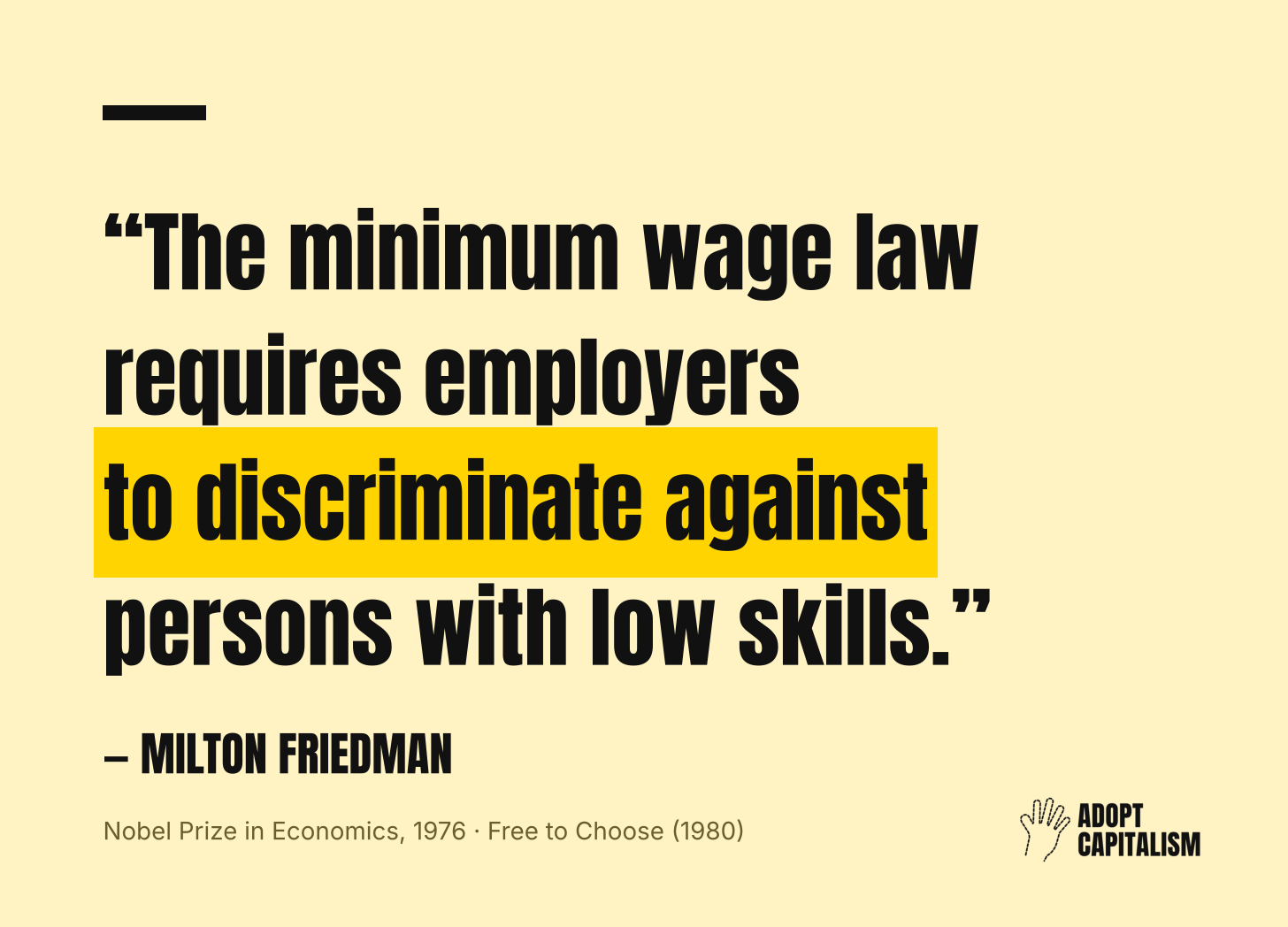
The minimum wage is one of the rhetorical slogans of socialism and communism that all of us, classical liberals and libertarians, still have to fight today. I say “still” because, despite endless examples of failure throughout history, statist policies like this one keep taking root in people’s minds, helped along by the constant socialist and statist drumbeat of the legacy media.
“Minimum wage” is an easy slogan to understand. Two words that, the moment you say them, make you sound like a champion of altruism and human rights.
If you don’t think about it too hard, the idea seems unassailable: the state should make sure, by law, that anyone who works earns at least enough to live on. Because it’s only fair that people who work shouldn’t do it for peanuts and be exploited. It sounds like common sense. Who could possibly be against it?
All of us should be. Because supporting a state-imposed minimum wage is a recipe for failure on the economic, social and moral levels. And its first victims are the very people it claims to protect.
So let’s look at how the minimum wage fails on each of these three fronts: economic, social and moral.
The economic failure: more unemployment
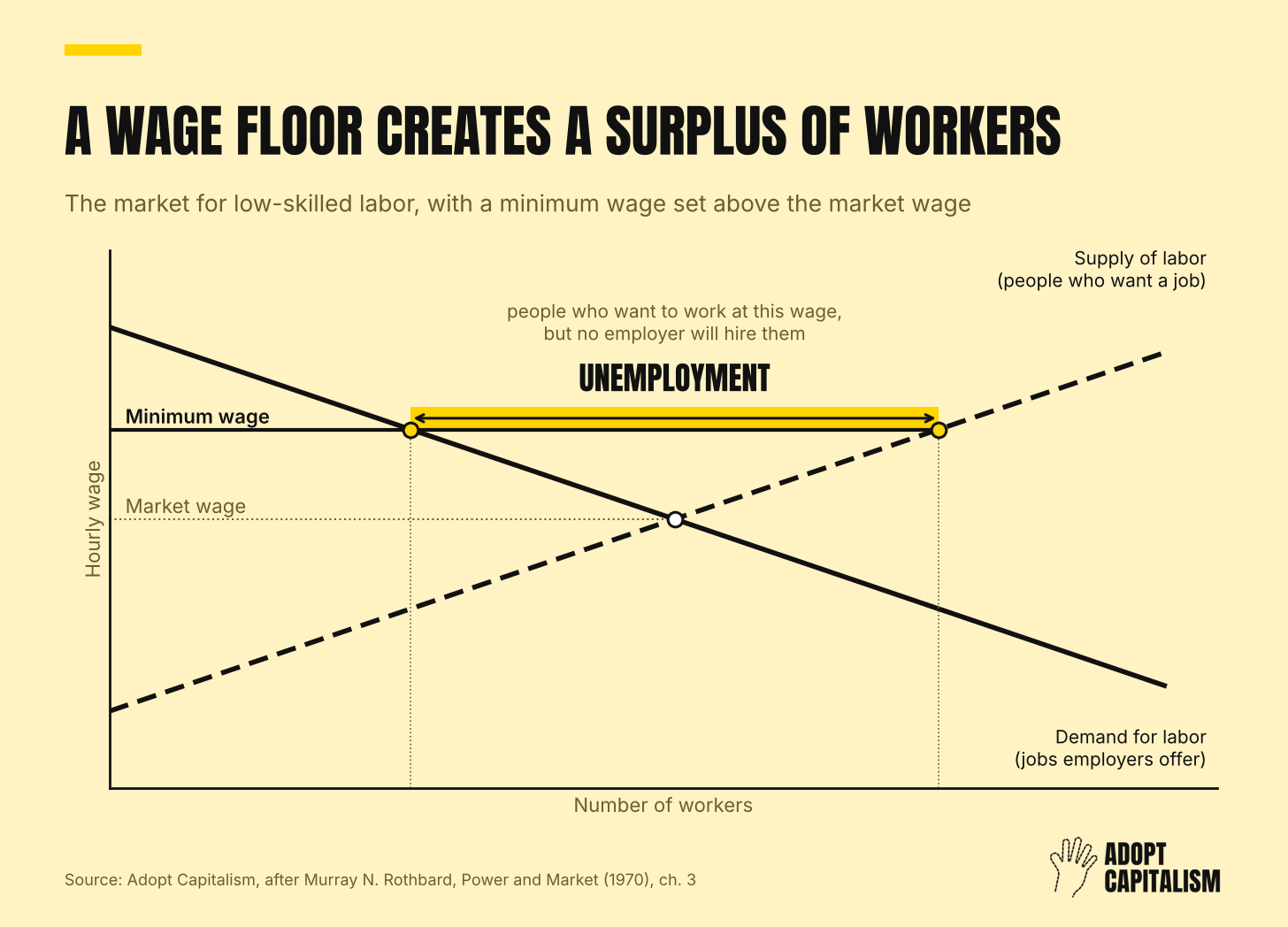
In a nutshell, the economic result of minimum wage laws is a sharp rise in unemployment. Over the years, many economists have explained the technical reasons why this happens. Personally, the explanation I’ve always liked best is the one by Murray Rothbard in chapter 3 of his masterpiece Power and Market, where he describes the harmful effects of state control over prices.
Rothbard explains that the state can set, by law, a maximum price, above which it is illegal to sell, or a minimum price, below which it is illegal to sell. A maximum price creates scarcity, and scarcity of a good or service typically brings lines, black markets, favoritism and, sometimes, the good or service simply running out (empty shelves). Many of the problems with public goods and services whose price is capped fall into this category, for example public healthcare in many European countries.
A minimum price creates the opposite: an unsold surplus. At the imposed minimum price there are more sellers than buyers, and part of what is offered goes unsold.
Now, a wage is nothing but a price: the price of labor. The seller is the worker; the buyer is the one who hires him.
“When a minimum wage law is effective, i.e., where it imposes a wage above the market value of a type of labor (above the laborer’s discounted marginal value product), the supply of labor services exceeds the demand, and this ‘unsold surplus’ of labor services means involuntary mass unemployment.”
— Murray N. Rothbard, Power and Market
That “discounted marginal value product” is how much one more worker adds to a business’s revenue.1 If a worker produces the equivalent of $10 an hour and the law forces you to pay him $15, no employer in his right mind will hire him. Not out of malice: he would simply lose $5 every hour.
And here’s the point: in the labor market, the unsold surplus has a name. It’s called unemployment.